Investigation 01: A Dormant Audience, Found by Accident
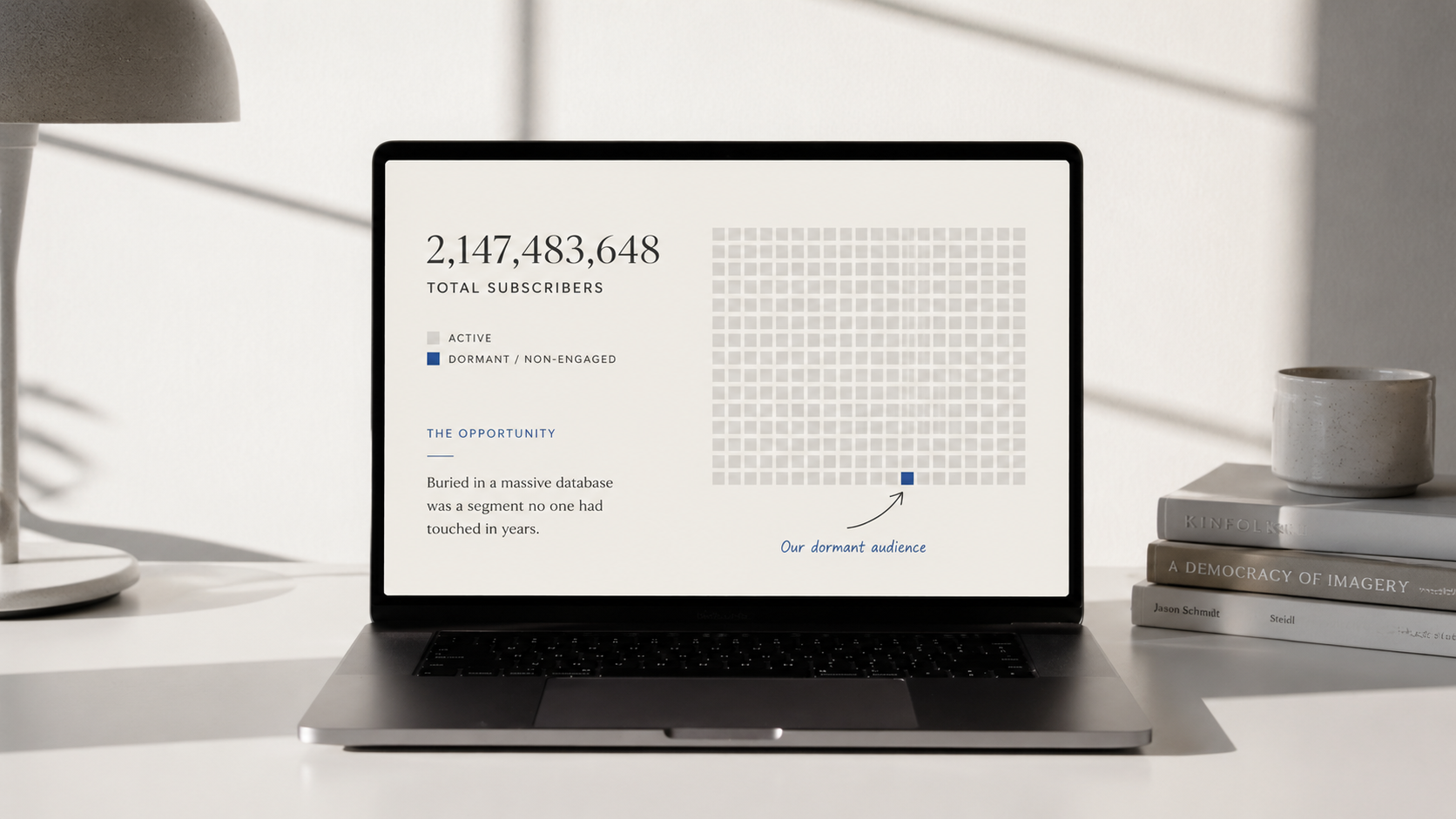
A campaign that started as a side effect of a data migration and ended up teaching me what “cold” actually means.
Project Overview | |
|---|---|
| Client | Wheel of Fortune (Sony Pictures Television) |
| Role | CRM Implementation, Message Testing & Performance Analysis |
| Timeline | 3-wave campaign, Apr–Jun 2017 |
| Tools | Salesforce Marketing Cloud · SQL · Excel |
| Scope | Win-back execution, non-opener waterfall targeting, subject-line testing, performance reporting |
Observation
I wasn't looking for this. I was training the Wheel of Fortune team on Salesforce Marketing Cloud, while also helping migrate Sony Pictures Television's shared subscriber database — over two billion records across seventeen business units.
Somewhere in that work, a segment surfaced that didn't fit anything I expected.
Not fatigued. Not decayed. No history of opens tapering off — because there was no history of opens at all. These people had never been meaningfully engaged. Not once, since the day they landed in the database.
That distinction changed how I looked at the problem.
A decayed list tells you a story: something worked, then stopped. A never-activated list tells you nothing. No prior behavior to read. No "what changed" to investigate. Just a large group of people, sitting there, with no record that anyone had ever tried to reach them.
The Question
The obvious move was to suppress the segment. Without any engagement history, there was little justification for continuing to send to them. But suppressing them also meant closing a door before anyone had knocked.
The question became something else entirely:
If no one had ever really tried to reach this group, how would we know who was still reachable?
Hypothesis
My instinct was that one campaign wouldn't answer that question.
A single send would treat 880,000 people as one audience, even though they almost certainly weren't.
I suspected we'd learn more by watching behavior unfold over time than by looking for one big result.
Investigation
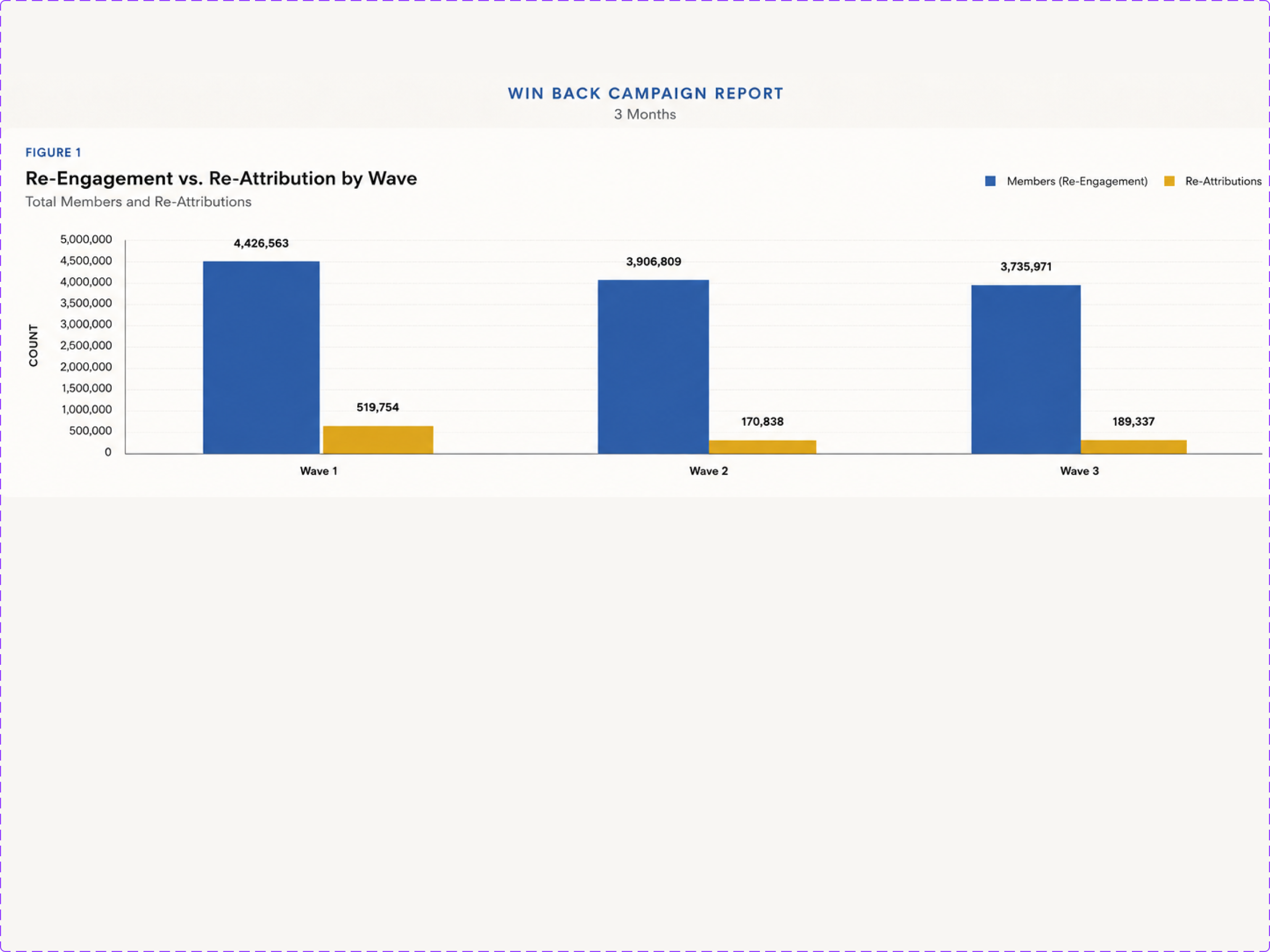
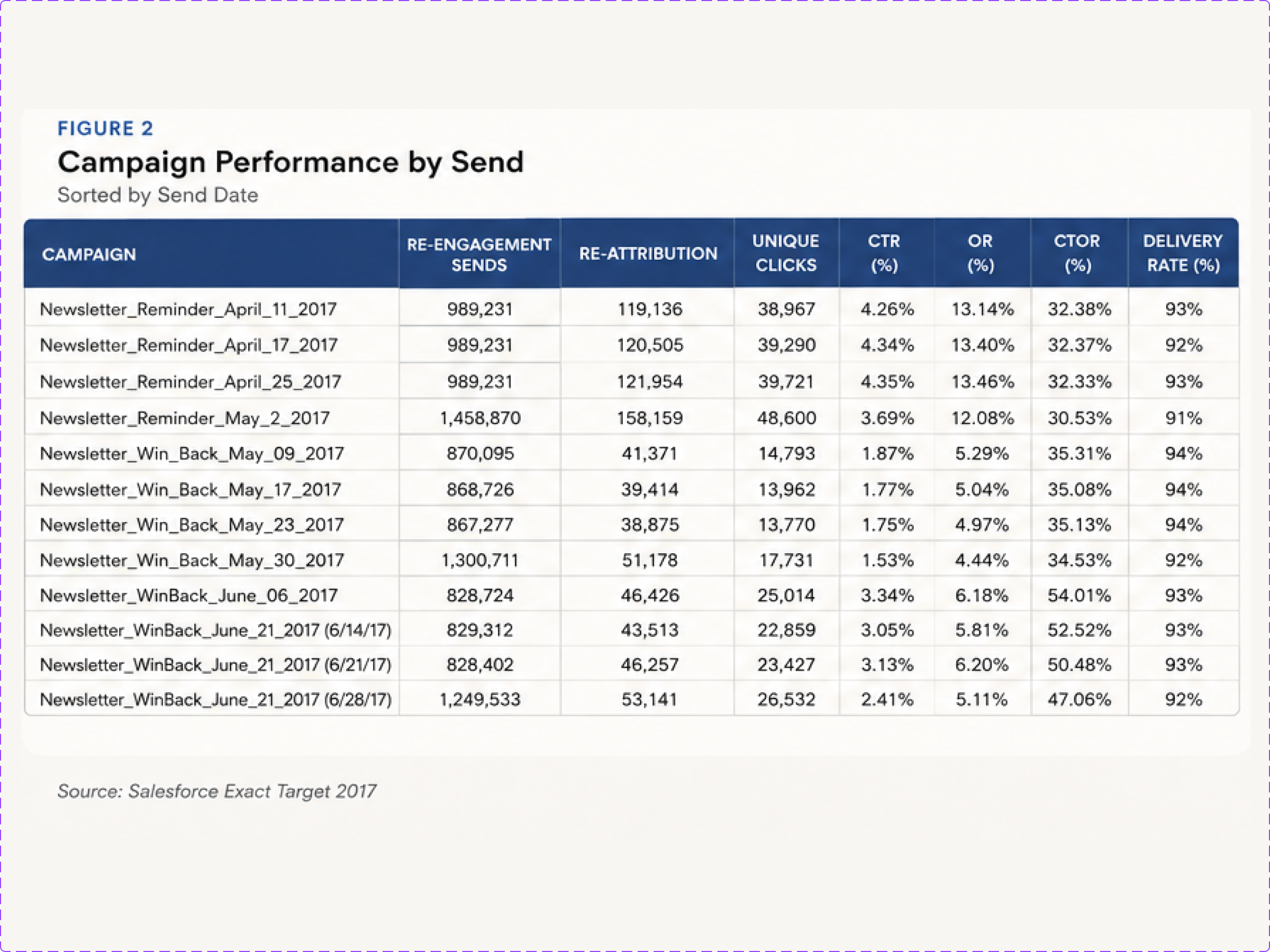
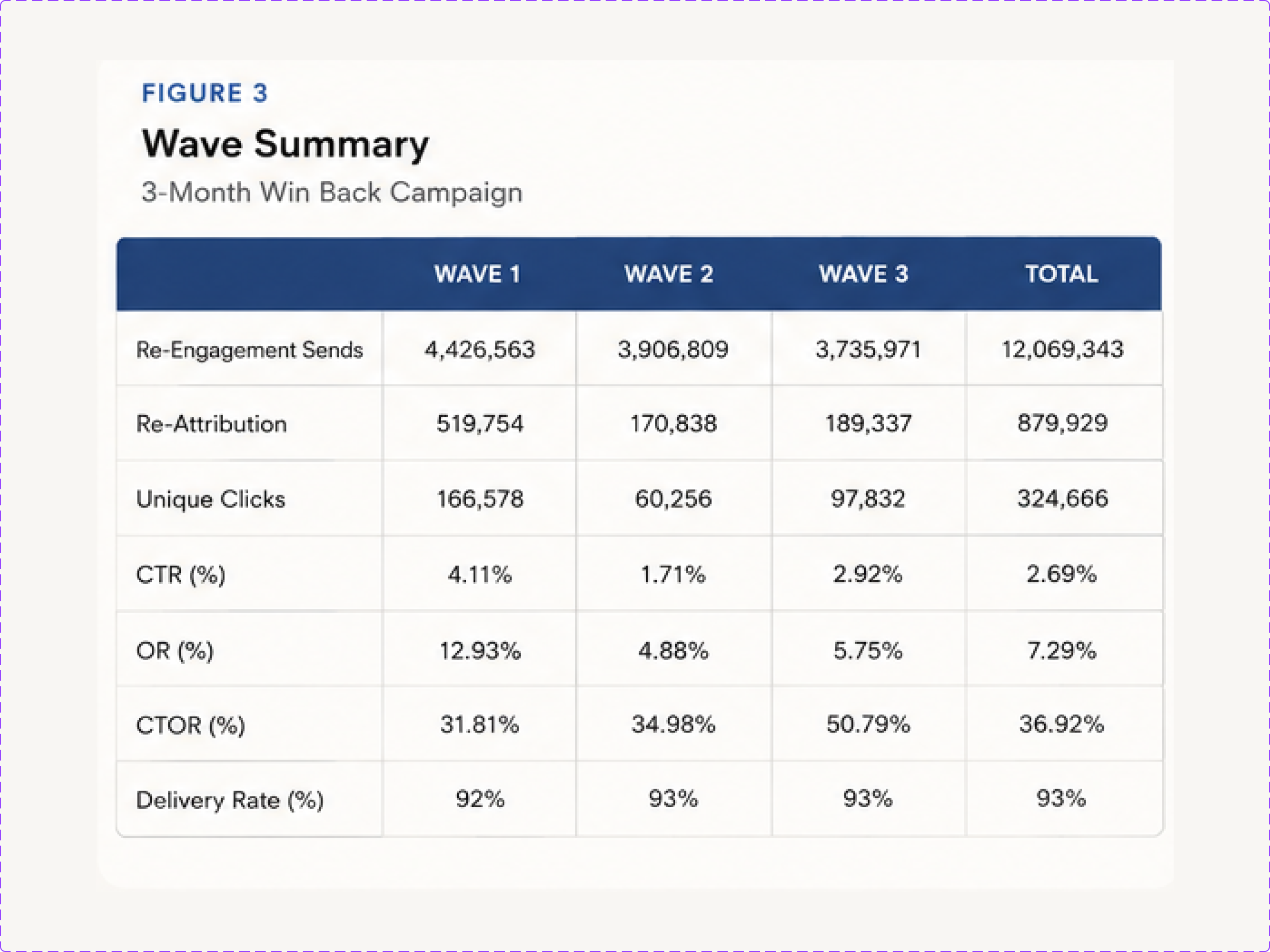
The decision to treat this as an experiment rather than suppress the segment wasn't mine. My manager saw enough potential to explore it. A data scientist built the segmentation logic that narrowed the audience after each send. My role was bringing the campaign to life: building the emails, deploying each wave, testing subject lines, and reporting on what the audience did next.
The campaign followed a simple three-wave structure. The first email went to everyone in the segment. The second went only to subscribers who hadn't opened the first. The third targeted only those who had ignored the first two. On paper, it looked like a typical waterfall campaign. In practice, each wave represented a different audience. The people remaining after two ignored emails weren't simply "the same list." They were becoming a more specific group with every send.
The messaging evolved alongside that audience. The first email was sent as Newsletter Reminder, assuming people had simply forgotten to engage. By the second and third waves, the framing shifted to Win-Back. After someone has ignored two emails, a gentle reminder no longer matches the moment. The campaign needed to acknowledge that we were speaking to a different audience than we had at the beginning.
The most interesting part of the investigation came during the final wave. We tested two subject lines against randomly split groups of the coldest remaining audience: "Don't Lose a Turn!" and "We're Taking You Off the List." At the time, it felt like another A/B test. The platform identified a winner within a couple of hours, and we moved on.
It wasn't until I went back through the raw campaign data that this test caught my attention. Unlike the broader campaign metrics, this comparison wasn't influenced by audiences changing from one wave to the next. Both subject lines were sent at the same time, to randomly matched groups of 80,203 subscribers. It was one of the few moments in the campaign where the message itself — not the composition of the audience — was the primary variable.
That changed how I interpreted the rest of the results. The wave-over-wave trends still mattered, but they compared different audiences at different stages of the campaign. They suggested a pattern. The subject-line test gave me something stronger: a cleaner comparison that helped explain why that pattern might exist.
Findings
The clearest result came from the subject-line test.
Both versions were sent to randomly matched groups of 80,203 subscribers at the same time, making it one of the few comparisons in the campaign where the audience itself wasn't changing.
| Subject line | Open rate | Click-to-open rate |
|---|---|---|
| Don't Lose a Turn! | 2.73% | 43.0% |
| We're Taking You Off the List | 5.96% | 52.9% |
The urgency-framed subject line didn't just outperform the loss-framed version. It more than doubled the open rate on an audience that had already ignored two previous emails.
Years later, it's still the finding I think about the most. The audience was the same. The timing was the same. The only meaningful difference was the message itself.
The broader campaign pointed in a similar direction, although with a little more uncertainty. Re-attributions declined from 519,754 to 189,337 while click-to-open rate increased from 31.81% to 50.79%.
At first glance, those numbers seem contradictory. Fewer people responded, yet the people who did were more engaged.
To me, they aren't separate findings. The waterfall suggested the audience became more defined as it narrowed. The subject-line test helped explain why. By the final wave, a gentle reminder wasn't what moved people. They needed a compelling reason to act now.
The campaign ultimately generated 879,929 re-attributions across more than 12 million subscribers while maintaining delivery rates between 92% and 93%. The structure was later reused in future win-back campaigns at Sony. I don't see that as proof that every decision was optimal, but it suggested we had uncovered an approach worth building on.
What Changed My Thinking
Before this project, I thought a non-response meant there wasn't much left to learn.
I don't think that anymore.
Every unanswered email tells you something. As the audience narrowed, the people who remained became easier to understand, not harder.
More importantly, this project changed how I think about urgency.
I used to think a cold audience needed a softer approach. Instead, I found that by the final wave, the opposite was true. The people who had ignored two previous emails weren't looking for another reminder. They needed a compelling reason to act now.
Since then, I've approached every campaign with a different question:
If people aren't responding, what reason have I actually given them to respond right now?